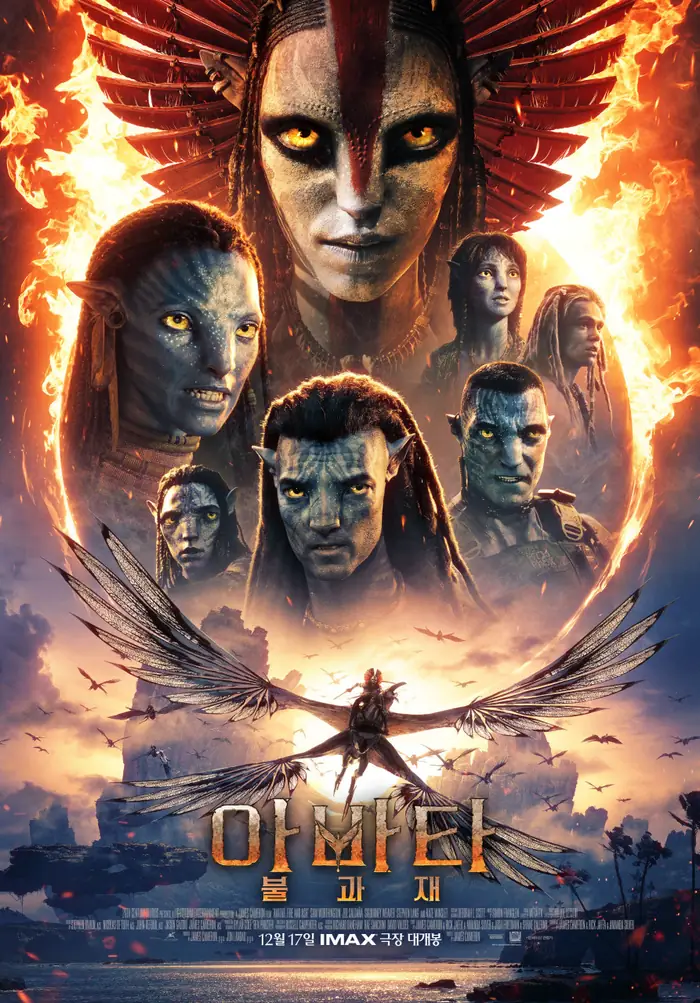
'Avatar: Fire and Ash' Explores Family and Identity in a World of Ash
Beyond the blue oceans, we now enter a world of 'Fire and Ash.' The film 'Avatar: Fire and Ash' reveals another face of Pandora, set against volcanic landscapes and ash-gray lands, taking the series' spectacle to a new level.
The movie opens with scenes of the Sully family remembering Neteyam in their own ways. The second son, Lo'ak, connects with his brother through the ancestral trees. The Na'vi worldview, where souls live on with Pandora even after the body is gone, views death not as an end, but as a 'connection.'
However, Neytiri remains immersed in grief. Jake, watching his wife, shoulders the additional responsibility of holding the family together as its leader.
In the early part of the film, Jake decides to entrust the human boy Spider to the Metkayina clan. Spider, born on Pandora but living in a human body, is always a 'figure on the border.' He is neither fully Na'vi nor fully human.
This decision is both an act of protection for Spider and an act of pushing away a potential threat to his own family. Jake's dilemma of having to let go of someone akin to family to protect his family brings back the persistent question of kinship that the 'Avatar' series has always explored.
However, this plan is shattered by the attack of the Ash People, led by Varang. This clan, native to volcanic regions and ash-covered lands, presents an image of fire and destruction, worshipping it as the 'purest existence.' Their existence differs from the harmonious coexistence with nature previously shown in the series.
Yet, the Ash People begin to change after meeting Colonel Quaritch. Wielding firearms used by the 'Sky People'—manufactured metal—their revered purity gradually becomes corrupted. This clearly illustrates why Pandora's clans despise the Sky People and symbolically represents nature's destruction by civilization.
'Avatar: Fire and Ash' pushes forward this narrative conflict with overwhelming visuals. Following the water-centric world of the first film, director James Cameron now presents a different Pandora, set against volcanic landscapes.
While the water clans depicted nature teeming with life, this time, the desolate terrain scattered with ash creates a stark contrast with the blue Pandora. This is not merely a change of background but a device to reveal another facet of nature. Varang's line, 'Eywa did not answer when my people were dying,' symbolically shows nature's capacity for both nurturing life and being cruel.
The issue of identity also permeates the work. Lo'ak grapples with what he must protect after his brother's death, and Spider wanders, unable to find a place to belong. Jake is constantly forced to make choices amidst his dual identity as a human and a Na'vi leader. 'Avatar: Fire and Ash' makes us ponder that identity is not innate but formed through numerous experiences and choices.
'Avatar: Fire and Ash' is a blockbuster boasting spectacular technology and grand scale, yet at its core lies the journey of family, loss, and the search for identity. sjay0928@sportsseoul.com
Korean netizens are praising the film's stunning visuals and compelling storyline, particularly resonating with the themes of family and identity. Comments include "The CGI is insane," "Great story, made me cry too," and "Can't wait for the next one."